War of Words Outside Parliament Sparks Fresh Political Controversy
A sharp and unexpected verbal confrontation between Leader of Opposition Rahul Gandhi and Union Minister Ravneet Singh Bittu unfolded outside the Parliament complex on Wednesday, quickly turning into a full-blown political controversy. What began as a chance encounter escalated into a heated exchange that drew in the Bharatiya Janata Party and reignited old political wounds.
The incident, which was caught on camera and widely shared, has since become the latest flashpoint in the ongoing political rivalry between the Congress and the BJP.
What Happened Outside Parliament
A Chance Encounter Turns Confrontational
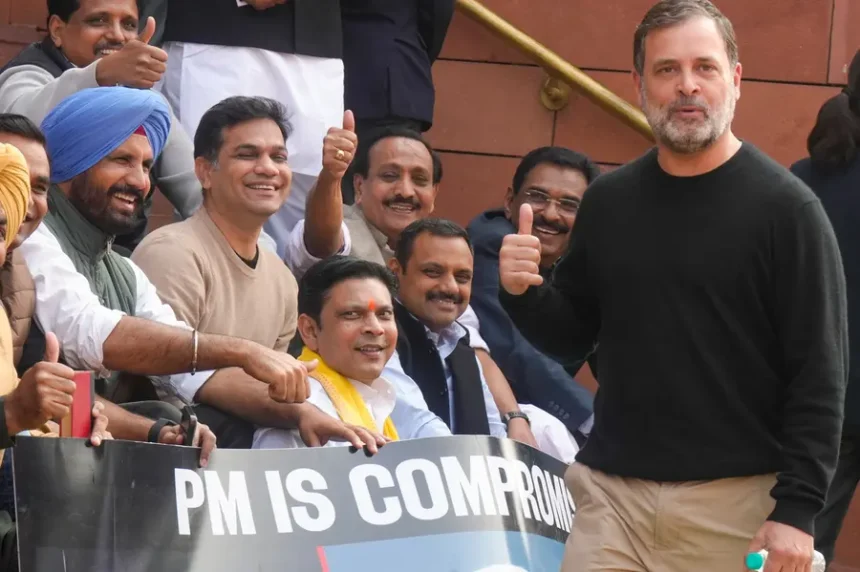
The confrontation took place when Rahul Gandhi and Ravneet Singh Bittu crossed paths near the Parliament premises. As the two leaders came face to face, Gandhi pointed towards Bittu and made a remark that immediately caught attention.
Referring to Bittu, Gandhi said, “Here is a traitor walking right by. Take a look at his face.” He followed it up by directly addressing Bittu as his “traitor friend” and remarked that Bittu would eventually return to the Congress. Gandhi even extended his hand for a handshake, adding a layer of irony to the comment.
Bittu Refuses Handshake
Ravneet Singh Bittu, who is currently the minister of state for railways, refused to shake hands with Gandhi. His refusal made the exchange even more awkward and visibly tense, signaling that the comment had crossed a personal and political line.
Bittu left the spot without engaging further, but the confrontation was far from over.
Why Rahul Gandhi Called Bittu a Traitor
From Congress Loyalist to BJP Minister
Ravneet Singh Bittu was once considered close to Rahul Gandhi and was a prominent Congress leader from Punjab. In 2024, he quit the Congress and joined the BJP, a move that shocked many within his former party.
Gandhi’s remark was widely interpreted as a reaction to this defection, which the Congress leadership has often described as betrayal rather than political disagreement.
Congress View on Defections
For the Congress, high-profile exits to the BJP are frequently framed as ideological betrayals, especially when they involve leaders who were once seen as part of the party’s inner circle. Gandhi’s choice of words reflected this sentiment, but it also opened him up to criticism for personal attacks.
Ravneet Singh Bittu Hits Back
Accuses Congress of Moral Superiority
Responding to Gandhi’s comments later, Bittu accused the Congress of believing it alone represented patriotism in the country. He claimed that Congress leaders saw themselves as the rightful rulers of India and dismissed others as lesser citizens.
“They think they are the biggest patriots,” Bittu said, alleging that the Congress had a long history of political arrogance.
Raises Historical Grievances
Bittu also brought up deeply emotional and historical issues related to Punjab and the Sikh community. He pointed out that while former Prime Minister Rajiv Gandhi was officially accorded martyr status after his assassination in 1991, the same recognition was not extended to his grandfather, Sardar Beant Singh.
Beant Singh, a Congress leader and former Punjab chief minister, was assassinated by a suicide bomber in 1992 during a period of intense militancy in the state. Bittu said this reflected selective remembrance and injustice within the Congress’s own legacy.
Strong Words on Sikh Issues
Refusal to Shake Hands Explained
In a subsequent statement, Bittu said he refused to shake hands with Gandhi because, in his view, the Congress party and the Gandhi family were responsible for grave injustices against Sikhs.
He referred to Operation Blue Star, the 1984 military operation ordered by then Prime Minister Indira Gandhi at the Golden Temple in Amritsar. Bittu said the operation deeply hurt Sikh sentiments and left lasting scars.
“Our holiest shrine was attacked. Sikhs, including women and families, were killed,” Bittu said, describing the events as unforgivable.
Emotional Undercurrent in the Debate
By invoking Operation Blue Star and the violence of the 1980s and early 1990s, Bittu shifted the confrontation from a personal exchange to a broader political and emotional argument, one that resonates strongly in Punjab politics.
BJP Rallies Behind Ravneet Singh Bittu
Sikh Leaders Condemn Rahul Gandhi’s Remark
Soon after the incident, the BJP came out in strong support of Bittu. Three senior Sikh leaders from the party addressed a press conference to condemn Rahul Gandhi’s comments.
Union Minister Hardeep Singh Puri, along with leaders Manjinder Singh Sirsa and Arvinder Singh Lovely, said calling a former party colleague a traitor was unacceptable, especially from the Leader of the Opposition.
BJP Questions Gandhi’s Language
Hardeep Singh Puri said that while Gandhi may be upset about Bittu leaving the Congress, there were more dignified ways to express disappointment.
“If he wanted, he could have called him a friend who drifted away. But branding someone a traitor and suggesting they will come back crosses a line,” Puri said.
The BJP framed the remark as reflective of an intolerant mindset and accused Gandhi of personalising political differences.
Rahul Gandhi Escalates Attack on BJP Later in the Day
Shifts Focus to National Security
Later on Wednesday, Rahul Gandhi escalated his criticism of the BJP and Prime Minister Narendra Modi on an entirely different front. Speaking to reporters in the Parliament House complex, Gandhi accused the Prime Minister of failing to fulfil his responsibility during the 2020 India-China standoff in the Kailash Range.
He claimed that the government had not been transparent about the situation on the border.
Controversy Over Former Army Chief’s Memoir
Gandhi referred to an unpublished memoir by former Army chief General Manoj Mukund Naravane, which he said he had been prevented from reading in Parliament since Monday.
According to Gandhi, the memoir contained important details that the country needed to know. He claimed the refusal to allow him to read from the book was an attempt to suppress uncomfortable truths.
Direct Challenge to the Prime Minister
“I don’t think the Prime Minister will have the guts to come to the Lok Sabha today,” Gandhi said, adding that if Modi did appear, he would present the book to him so that “the truth” could come out.
The statement added another layer of confrontation to an already charged political day.
Political Fallout and What Comes Next
A Personal Spat with Wider Implications
What began as a brief exchange outside Parliament has now snowballed into a wider political debate involving party loyalty, historical grievances, and national security.
For the Congress, Gandhi’s remark has energized supporters who see defectors as opportunists. For the BJP, the incident has provided an opportunity to portray Gandhi as divisive and disrespectful.
Likely to Echo in Parliament and Beyond
With Parliament in session and tensions already high, the confrontation is likely to be referenced repeatedly in debates, press conferences, and campaign speeches.
As both parties harden their positions, the episode highlights how personal history and political rivalry continue to shape India’s parliamentary politics.