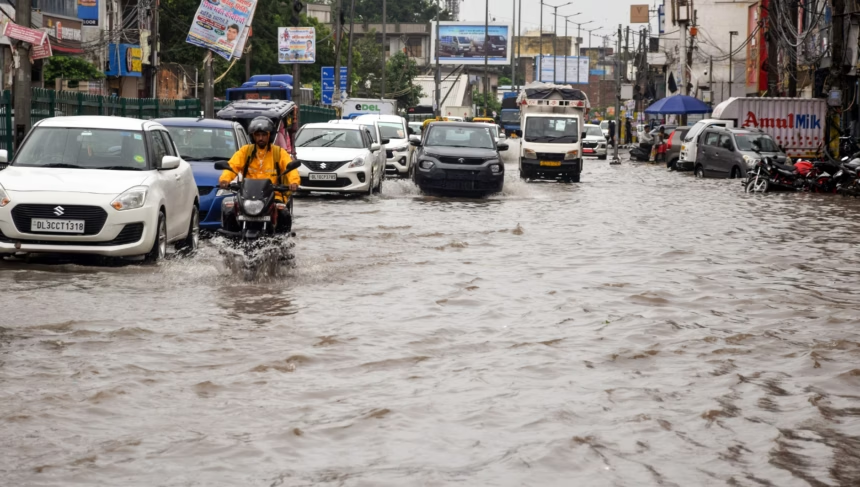
A stretch of central Delhi, connecting ITO to the Supreme Court Metro Station, has plunged into chronic chaos due to continuous waterlogging caused by a damaged underground pipeline. What began as a minor leakage has ballooned into a big civic problem severely disrupting traffic flow in one of the capital’s busiest corridors. As no permanent repair work has been started yet, thousands of commuters, officegoers, and students have been bearing the brunt of slow-moving traffic, bottlenecks, and daily delays.
A Critical Artery Under Water
The stretch that has been hit is right in the middle of Delhi’s institutional zone, which boasts the Supreme Court of India, the Delhi High Court, numerous government offices, media houses, and educational institutions. The road is an important link between central government districts and major transport hubs such as ITO, Pragati Maidan, India Gate, and Tilak Marg.
Officials and commuters say the problem started when a water pipeline running underneath the road was damaged during digging work by a civic agency. The leakage, initially small, gradually increased as pressure built up, leading to constant waterlogging on the surface. While temporary pumping and drainage measures temporarily relieved the situation, water still collects there every few hours.
Daily Traffic Snarls and Peak-Hour Gridlock
The traffic congestion at this junction has become a commuter’s nightmare. During peak hours, long queues of vehicles can be seen from ITO to the Supreme Court roundabout-a route where even minor delays usually ripple throughout the entire central Delhi traffic network.
Motorists say the congestion has added anywhere between 20 to 40 minutes to their daily commute. Two-wheelers, especially, run the biggest risk as the waterlogged patches create slippery surfaces and increase the chances of skidding and accidents.
Public transport has not been spared either. A number of DTC bus drivers have complained that navigating the flooded stretch slows down routes extending to South Delhi, East Delhi, and Connaught Place.
Residents, Office-Goers Vent Ire
Continuous waterlogging has created irritation among local residents and daily commuters. Several videos of bumper-to-bumper vehicles have surfaced on social media, with some commuters being compelled to shift lanes or drive dangerously close towards dividers to avoid deeper water pockets.
Office-goers who work in nearby zones, including the Supreme Court complex, Delhi Police headquarters, Mandi House, and the Bar Council, agree that the situation has turned an already congested stretch into an unpredictable choke point.
The local shopkeepers and vendors complain that the standing water has started destroying the pavements and increasing foul odor, particularly during warmer afternoons.
Civic Agencies Under Scrutiny
Worse, agencies have engaged in the blame-game here to such an extent that clear accountability has yet to be established. The road and pipeline fall under the jurisdiction of multiple bodies — Delhi Jal Board (DJB), Public Works Department (PWD), and the New Delhi Municipal Council (NDMC).
While DJB officials claim to have pinpointed the leakage and asked for permission to excavate, PWD sources said the damage was caused by digging or maintenance work conducted by some other department recently. No agency has confirmed the timeline for repairs, leaving the commuters in limbo.
Urban planners say the incident exposes the lack of coordination among Delhi’s civic authorities-a continuing problem that magnifies minor technical faults into hours of public inconvenience.
A Safety Hazard Waiting to Escalate
Besides inconvenience due to delays, waterlogging is a serious safety hazard. According to traffic police, the stretch of road beneath the waterlogging will gradually weaken and develop cracks or even potholes. If the intermittent flow of water continues, it could result in severe structural damage.
The Delhi Traffic Police has placed cones and deployed staff to regulate the traffic, but they admit that this is unsustainable without prompt engineering intervention.
What Commuters Demand
Immediate action has been demanded by citizens in three areas:
Permanent repair of the damaged pipeline
Agencies coordination to avoid digging again and again
Improved road surface and drainage systems.
Various RWAs and office groups in the locality have petitioned concerned authorities to expedite the permissions and start repair work before things worsen further. Conclusion The continuous waterlogging near the Supreme Court-ITO stretch is a grim reminder of just how fragile Delhi’s urban infrastructure continues to be. A single damaged pipeline has crippled movement in one of the city’s most important traffic arteries, inconveniencing thousands daily. Unless civic bodies act in swift and coordinated concert, the problem may snowball into long-term structural damage and deeper public inconvenience.