India’s Urban Traffic Crisis: Are Roads Failing to Keep Up With Exploding Vehicle Growth?
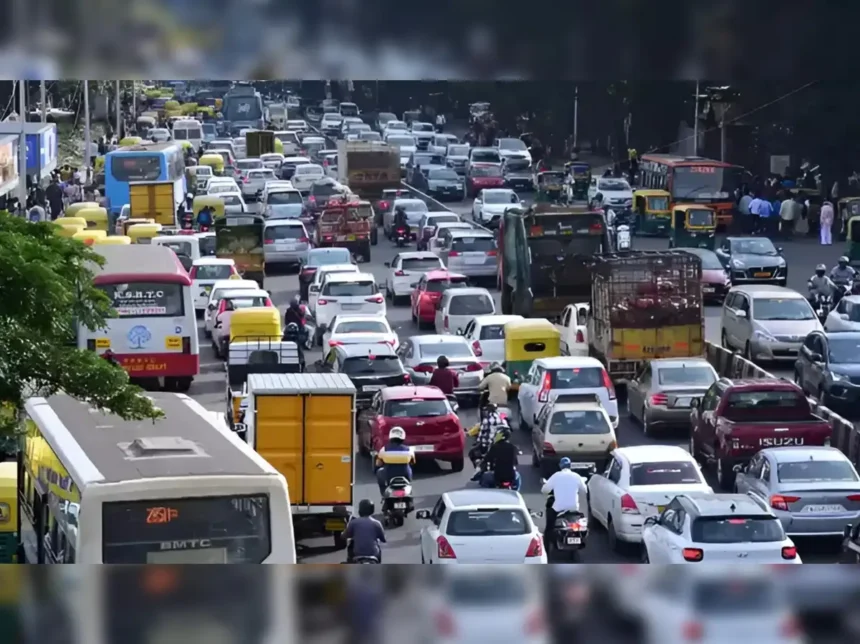
Traffic congestion has become a daily struggle in almost every major Indian city. From choking flyovers to endless bumper-to-bumper stretches, urban mobility is hitting breaking point. On Monday, Biocon chairperson and Bengaluru entrepreneur Kiran Mazumdar-Shaw reignited this debate on X by calling out the massive mismatch between vehicle growth and road infrastructure across India.
Her post, which quickly caught public attention, included a comparative graphic showing just how wide the gap has grown between the number of registered vehicles and the total road length in leading metros.
Mazumdar-Shaw summed it up starkly: India is dangerously short of roads.
But soon after, a new question emerged — is building more roads even the right solution?
What Kiran Mazumdar-Shaw Highlighted: Vehicles Rising, Roads Stagnant
Mazumdar-Shaw’s concern rests on a simple but alarming observation: Indian cities are witnessing massive vehicle growth, but road expansion is nowhere near enough to keep pace.
Delhi
Delhi tops the list with about 1.54 crore registered vehicles. Despite being India’s largest urban road network, the capital city still has only 32,000 km of roads. The pressure is obvious — every major road, flyover and intersection feels overloaded.
Bengaluru
Bengaluru, a city synonymous with traffic jams, has nearly 1.2 crore vehicles but just 12,878 km of road length. The city’s infrastructure has long been criticized for lagging behind its rapid population and tech-driven economic boom.
Chennai
Chennai has reportedly crossed 64 lakh vehicles but has only around 6,000 km of roads. With large residential clusters and expanding suburbs, limited road capacity has only worsened peak-hour congestion.
Pune
Pune has about 53 lakh vehicles but barely 2,100 km of road network, making it one of the most strained cities on the list.
Mumbai
Surprisingly, Mumbai — despite its dense population — has fewer vehicles at around 42 lakh. However, with just 2,000 km of roads, the city remains one of India’s toughest places to drive in.
Kolkata
Kolkata’s vehicle population stands at around 25 lakh, with road length close to 1,850 km, among the lowest in major metropolitan areas.
In each case, the numbers tell the same story: vehicle growth has surged far ahead of available road space.
Is More Road Construction the Solution? Experts Say No
While Mazumdar-Shaw focused on the shortage of roads, several urban mobility experts argued that simply adding more asphalt is not enough — and might not even help.
Arjit Soni, founder of MYBYK, responded directly to her post, challenging the popular belief that expanding roads will reduce congestion.
“Has Delhi solved traffic despite 32,000 km of roads?”
Soni pointed out that even India’s city with the largest road network continues to face crippling traffic. His argument reflects a growing urban planning consensus: Indian cities must reduce dependence on private vehicles, not create more space for them.
He suggested that meaningful solutions lie in improving:
- Public transportation systems
- Safe walking and cycling infrastructure
- Last-mile connectivity
- Strict enforcement of parking rules
- Policies that discourage unnecessary private vehicle use
“We need all of the above before we say we need more roads,” he said.
Public Voices Call for Stronger Measures
Many social media users sharply disagreed with the idea of expanding road networks, arguing that it would only encourage more private vehicle purchases.
One user wrote that India is “drowning in private cars and starving for decent public transport,” adding that road widening cannot possibly keep up with exponential vehicle growth. Instead, the commenter called for aggressive policies such as:
- Caps on new vehicle registrations
- Congestion pricing in busy zones
- Penalties for single-occupancy vehicles
- Rewarding public transport usage
The sentiment reflects a global trend: cities worldwide are moving away from private vehicles and prioritizing mass transit, efficient traffic systems, and walkable infrastructure.
The Bigger Picture: India’s Vehicle Count is Set to Double by 2050
While current traffic is already overwhelming, future projections are even more alarming. According to research by CEEW, India’s total number of vehicles is expected to more than double, rising from 226 million in 2023 to nearly 494 million by 2050.
Of the projected total:
- About 350 million will be two-wheelers
- Two-wheelers will account for nearly 70 percent of all vehicles
- Major regions like Delhi, Bengaluru, Thane and Pune will make up over 10 percent of the country’s total vehicle stock
If road infrastructure is already struggling today, the next two decades could see urban mobility pushed into permanent gridlock unless major changes are made.
Why India’s Traffic Woes Keep Getting Worse
India’s vehicle boom is driven by multiple factors, including rising incomes, affordable financing, increased urban migration, and insufficient public transport. Roads, however, have remained largely unchanged in many cities or expanded far too slowly.
Key reasons behind the growing congestion:
- Private vehicles are more accessible than ever
- Public transport has not expanded at proportional speed
- Last-mile connectivity issues force people to rely on personal vehicles
- Urban planning often prioritizes vehicles over pedestrians
- Parking rules are poorly enforced
- City centers remain overcrowded and underregulated
As a result, even cities with large road networks — like Delhi — continue to face intense congestion because the sheer volume of vehicles overwhelms what the roads can handle.
What Cities Need Now: A New Approach to Mobility
Urban experts increasingly agree that Indian cities need a multi-layered strategy instead of a single solution.
Strengthen Public Transport
Metro expansion, more buses, and high-frequency services can bring down private vehicle usage significantly.
Improve Walking and Cycling Infrastructure
Safe footpaths, cycle lanes, and pedestrian-friendly crossings can reduce short-distance vehicle trips.
Regulate Private Vehicle Growth
Measures like congestion pricing, parking limits, and registration caps have succeeded in cities like Singapore and London.
Encourage Shared Mobility
Carpooling, bike-sharing, and ride-hailing can reduce the number of vehicles on the road.
Smart Traffic Management
Better signaling, traffic automation, and tech-driven monitoring can reduce choke points.
Without these interventions, roads alone cannot keep Indian cities moving.
The Road Ahead: Time to Rethink Urban Mobility
Kiran Mazumdar-Shaw’s post sparked a much-needed conversation about India’s traffic crisis. Her data reflects a reality everyone can see but few address: Indian cities are expanding their vehicle population far faster than their road networks.
But the public response highlights an even larger truth — building more roads may not be the miracle fix it once seemed. As experts argue, the real solution lies in reducing dependence on private vehicles and investing heavily in better public transport and smarter city planning.
India’s traffic problem is not just about overcrowded roads. It is about the kind of cities we want to build for the future — cities built for people, not just for vehicles.