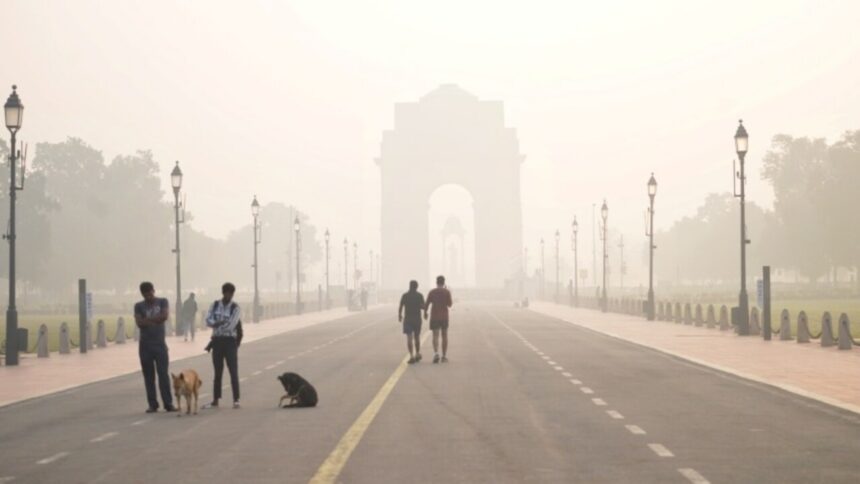
As the festive season approaches, Delhi is once again battling the return of toxic air. The capital’s air quality remained in the ‘poor’ category for the fourth day in a row, with an Air Quality Index (AQI) of 242 recorded on Friday morning.
Pollution levels are expected to worsen in the coming days, with some parts of the city already crossing into the ‘very poor’ category.
Delhi’s AQI on Friday: Area-Wise Pollution Levels
Here’s a look at AQI readings across different parts of Delhi on Friday morning:
| Area | AQI Level |
|---|---|
| Akshardham | 369 (Very Poor) |
| Bawana | 310 (Very Poor) |
| CRRI Mathura Road | 290 (Poor) |
| Nehru Nagar | 268 (Poor) |
| Anand Vihar | 252 (Poor) |
| Okhla Phase 2 | 247 (Poor) |
| Narela | 244 (Poor) |
| JLN Stadium | 230 (Poor) |
| Lodhi Road | 161 (Moderate) |
According to the Central Pollution Control Board (CPCB):
- 0-50: Good
- 51-100: Satisfactory
- 101-200: Moderate
- 201-300: Poor
- 301-400: Very Poor
- 401-500: Severe
What’s Causing the Pollution Spike?
Delhi’s worsening air quality is driven by multiple seasonal and human-made factors:
- Transport emissions were the top contributor on Thursday, accounting for 18.7% of total pollution.
- Stubble burning in neighboring states adds to the toxic haze, especially as Diwali nears.
- Calmer winds and dropping temperatures in winter trap pollutants close to the ground.
The Air Quality Early Warning System predicts that similar conditions will persist over the next few days, with no major improvement expected.
Diwali and Green Crackers: What’s Allowed This Year?
In a significant move, the Supreme Court has permitted the sale and use of green firecrackers in Delhi-NCR — but under strict conditions.
Here’s what you need to know:
- Only green crackers are allowed.
- Bursting time is limited to:
- 6 AM to 7 AM
- 8 PM to 10 PM
- Applies to the day before Diwali and Diwali day only.
- This relaxation is a “test case” and will be monitored closely.
The Delhi government has pledged strict enforcement, forming monitoring teams and coordinating with:
- Green cracker manufacturers
- Delhi Police
- MCD
- Department secretaries and traders
Designated cracker sale points will be set up, and unauthorized sales will be penalized.
Pollution and Public Health: Who’s at Risk?
Experts have raised concern over the rising health risks associated with Delhi’s air, particularly during festive seasons.
People most vulnerable to high pollution levels include:
- Children and infants
- Pregnant women
- Elderly citizens
- Individuals with asthma, COPD, or heart conditions
They’re advised to:
- Avoid prolonged outdoor exposure
- Use N95 masks if stepping outside
- Keep air purifiers on indoors
- Stay hydrated and avoid vigorous exercise outdoors
Delhi Government’s Post-Diwali Plan: Artificial Rain
In preparation for a potential spike in pollution after Diwali, the Delhi government is considering artificial rain as part of its emergency pollution control strategy.
The plan, if approved, would involve cloud seeding techniques to induce rainfall — temporarily clearing the air. Meetings with environmental experts and meteorologists are underway to assess feasibility and timing.
List of India’s Most Polluted Cities on Thursday
Delhi wasn’t alone in facing choking air. Several Indian cities recorded AQIs well over 300. According to available data, five stations in Delhi alone crossed into the very poor category.
The list of most polluted cities this week is expected to grow as winter deepens and Diwali activities spike emissions.
Final Thoughts: What Lies Ahead for Delhi?
Delhi’s clean-air streak, which began in June 2025 and lasted through much of the monsoon, is now officially over. With Diwali around the corner, the city is bracing for an even more toxic atmosphere.
While government initiatives like green crackers and artificial rain may help in the short term, long-term solutions — such as cleaner fuel adoption, reducing vehicular emissions, and stricter industrial regulations — remain critical.
Until then, staying informed, taking precautions, and minimizing personal contribution to pollution are small but important steps citizens can take.