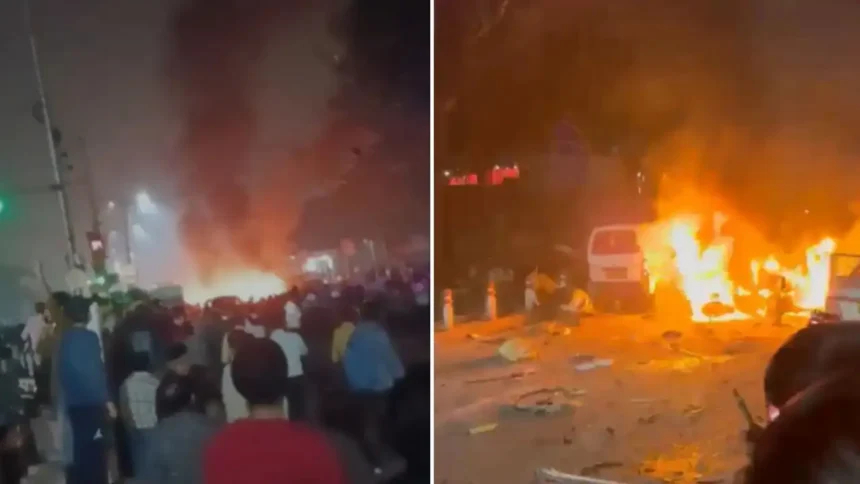
A City on Edge After a Powerful Blast
Delhi woke up to tension and uncertainty after a high-intensity explosion outside the historic Red Fort on Monday evening left at least eight people dead and several injured. As investigators raced against time, the focus has now shifted to the first report from the Forensic Science Laboratory (FSL), expected today, which could finally reveal what caused the deadly blast.
What the FSL Report May Reveal
According to Delhi Police Special Cell sources, the FSL’s initial report will shed light on the composition and nature of the explosive material recovered from the site. Early tests have hinted at traces of ammonium nitrate — a common industrial chemical that has also been used in previous explosions — but officials say confirmation will come only after detailed forensic analysis.
Police sources were careful to clarify that, so far, no evidence points to an improvised explosive device (IED). The findings from the FSL will be key in determining whether the blast was accidental or an act of deliberate sabotage.
Explosives Trail Leads to Faridabad and Pulwama
Investigators are piecing together a complex trail that links Delhi, Haryana, and Jammu and Kashmir. The Special Cell has reached out to both the Faridabad Crime Branch and the J&K Police for details on explosives recently seized from Faridabad.
This comes after the recovery of 360 kg of explosives and ammunition from Faridabad in a joint operation by Haryana and J&K Police, where two suspects — identified as Dr. Muzammil and Aadil Rather — were arrested. Police are now exploring whether the Red Fort blast has any connection to that cache.
Adding to the intrigue, the Delhi Police have traced the car involved in the explosion — a Hyundai i20 — back to Pulwama, a district in Jammu and Kashmir often in the spotlight for security concerns. The car was reportedly bought by a Pulwama resident, and investigators believe the vehicle entered Delhi from Haryana via the Badarpur border.
CCTV Footage Offers Key Clues
Over 100 CCTV clips from the route leading to Red Fort are being closely examined. According to police sources, footage shows the suspect’s i20 car entering and exiting the parking area near the historic monument. The driver appeared to be alone at the time.
Investigators are now retracing the vehicle’s path through Daryaganj and nearby areas. The footage is being analyzed from toll plazas, the Badarpur border, and major roads like the Outer Ring Road and the Kashmere Gate–Red Fort stretch. Around 200 officers have been assigned to review surveillance data to piece together the full journey of the suspect and the car.
Late-Night Raids and Questioning
Soon after the blast, Delhi Police launched extensive search operations across nearby areas, including Paharganj, Daryaganj, and other parts of central Delhi. Teams scoured hotel registers and carried out overnight raids to locate anyone who may have checked in around the time of the explosion.
During these operations, four individuals were detained for questioning. Police say that at least 13 people are now under close scrutiny based on CCTV evidence and other leads. One of the men believed to be linked to the Faridabad module may have been traveling in the i20, though his identity will be confirmed only after DNA testing.
Government and Security Agencies Step In
Union Home Minister Amit Shah was briefed soon after the incident. In his first reaction, he confirmed that the National Investigation Agency (NIA) and the National Security Guard (NSG) have been called in to assist with the probe. While officials are cautious about labeling it a terror attack at this stage, they admit the scale and nature of the blast make it a “difficult and sensitive” case.
A senior Delhi Police officer added that the injuries from the blast did not appear consistent with those typically caused by bomb shrapnel or pellets, further deepening the mystery surrounding what exactly triggered the explosion.
A City Under Watch
The blast site near the iconic Red Fort — one of Delhi’s busiest tourist attractions — has been cordoned off as forensic teams continue their work. Traffic restrictions and security checks have been tightened across the city, especially at border points and near historical landmarks.
Investigators are leaving no stone unturned as they wait for the FSL report, which will likely determine the next steps in the case. If ammonium nitrate is confirmed, it could indicate either a crude explosive mix or an industrial accident. If another chemical composition is found, it may point to a more sophisticated setup.
What Happens Next
Once the FSL findings are in, the Delhi Police will share them with the NIA and NSG for further assessment. The focus will then shift to tracing how the explosives reached Delhi, who was driving the car, and whether the incident was part of a larger network.
For now, Delhi remains on alert. With multiple agencies — including the Delhi Police Special Cell, NIA, and NSG — working in coordination, the next 24 hours are expected to be crucial in unraveling the mystery of the Red Fort blast.