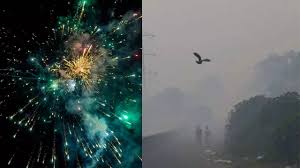
As winter sets in, Delhi is again blanketed by a thick shroud of smog, and air quality levels drop to the “very poor” category in most areas of the city. In a last-ditch effort to try and battle worsening pollution, officials resorted to cloud-seeding — a form of weather modification that is used to induce artificial rain — but preliminary indications indicate that the much-hyped rainfall never came.
According to data from the Central Pollution Control Board (CPCB), Delhi’s Air Quality Index (AQI) on Tuesday hovered between 308 and 322 in several localities, including RK Puram, Anand Vihar, and Bawana. These readings fall under the “very poor” category, meaning that prolonged exposure could lead to respiratory issues, especially among children and the elderly. With wind speeds still low and temperature inversions holding pollutants close to the ground, meteorologists warn that conditions may actually get worse over the next few days.
The Delhi administration, with the support of the Indian Institute of Technology (IIT) Kanpur and the India Meteorological Department (IMD), carried out cloud-seeding experiments on Monday in a bid to induce artificial rain. This was as part of a wider emergency measure aimed at cutting airborne particulate matter and providing temporary respite to the residents of the city. Officials, however, later announced that the experiment did not produce rain, attributing it to low cloud moisture.
Cloud seeding is not a miracle solution — it is a matter of atmosphere,” an IMD scientist who participated in the project explained. “Though there were some encouraging cloud formations, the humidity levels were too low to support precipitation. The experiment has, however, yielded useful data that will inform future interventions.
Despite the setback, Delhi’s government has vowed to continue exploring advanced pollution-control measures. Environment Minister Gopal Rai reiterated that authorities are doing everything possible to mitigate the crisis. “We are working with scientists and agencies to deploy both short-term and long-term solutions. Cloud-seeding is one of several experimental approaches, but our focus remains on reducing emissions at their source,” Rai said during a press briefing.
The direct on-ground actions are the imposition of Stage II of the Graded Response Action Plan (GRAP), restricting construction and demolition activities, prohibiting the entry of non-BS VI diesel vehicles from other states, and speeding up mechanical road cleaning and water sprinkling. The enforcement teams have also been instructed to act sternly against open burning of trash and unauthorized industrial emissions.
Experts caution that these short-term solutions are not enough to address Delhi’s persistent pollution problem. “Cloud seeding and water sprinkling are reactive measures — not preventive ones,” said environmentalist Vimlendu Jha. “The solution is actually in eliminating the sources — vehicular, industrial, and stubble burning in surrounding states. Unless we do something about these sources together, we’ll remain stuck in the same vicious cycle year after year.”
Indeed, satellite imagery over the past week has shown a sharp rise in stubble burning incidents across Punjab and Haryana. The smoke from these agricultural fires, combined with urban emissions and stagnant wind conditions, has turned Delhi’s air toxic. The contribution of stubble burning to Delhi’s pollution currently stands at an estimated 25–30%, according to SAFAR (System of Air Quality and Weather Forecasting and Research).
Health experts have raised alarms over the sharp increase in respiratory complaints in the National Capital Region. Hospitals are reporting a surge in patients suffering from coughing, wheezing, and throat irritation. Dr. Arvind Kumar, a senior pulmonologist at Medanta Hospital, said, “We’re seeing children and even young adults with symptoms of bronchitis and asthma exacerbation. The pollution levels today are equivalent to smoking several cigarettes a day.”
Citizens are being asked to steer clear of outdoor exercise, wear N95 masks, and opt for air purifiers indoors where possible. Schools in various districts have been instructed to curtail outdoor activities for students.
While the Delhi government’s cloud-seeding experiment is an innovative move towards climate-based pollution control, the experiment highlights the challenge. Lacking regional cooperation and long-term control on emissions, even technology interventions bring little respite.
As the smog thickens and the city braces for more days of poor air, the episode stands as both a warning and a wake-up call. Delhi’s air crisis is no longer a seasonal inconvenience — it’s a chronic public health emergency demanding systemic reform. Whether through stricter emission standards, cleaner transportation, or agricultural innovation, the capital’s fight for breathable air must now move beyond short-term experiments to enduring action.