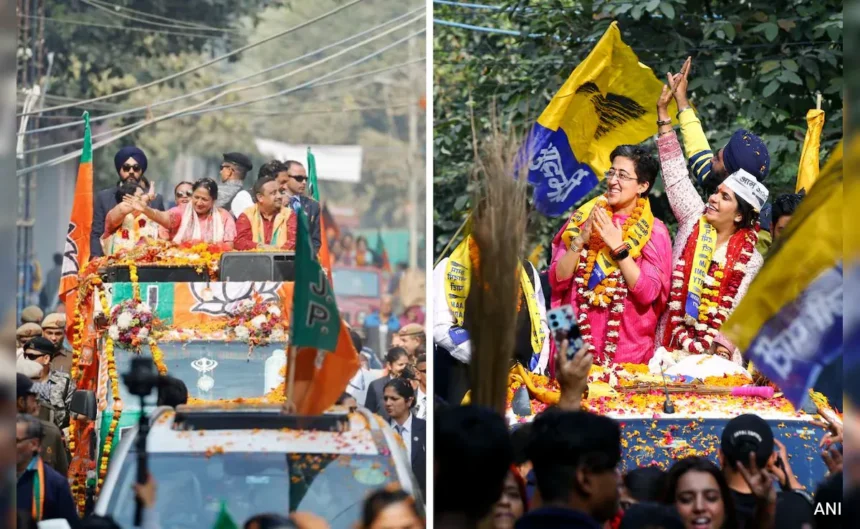
The by-elections to the Municipal Corporation of Delhi, held across 12 wards in 2025, concluded with a politically charged outcome that reflects both continuity and subtle shifts in the capital’s civic landscape. The results, declared on 3 December 2025, saw the Bharatiya Janata Party win seven seats, followed by the Aam Aadmi Party securing three, while the Indian National Congress and All India Forward Bloc bagged one seat each. Though small in scale, the by-elections assumed considerable political importance due to the emerging power dynamics within the MCD and the upcoming electoral cycles.
These by-elections were caused by vacancies owing to resignations, deaths, and elected councillors moving on to legislative positions. Thus, every major party saw this contest as an important midpoint indicator of peoples’ sentiment. The BJP was trying to increase its already commanding majority; AAP was trying to regain lost momentum after recent political setbacks, and Congress was fighting to retain relevance. The surprise win by the Forward Bloc added an unplanned element to the eventual result.
BJP Maintains its Stronghold
Once again, the BJP turned out to be the biggest gainer as the party won wards such as Chandni Chowk, Ashok Vihar, Greater Kailash, Shalimar Bagh, Dwarka-B, and Dichaon Kalan. These victories, in fact, reestablished the urban presence of the party and its efficient organizational machinery. Though the party was not able to get all seats it was targeting, victories in the majority of the wards meant it could again lead the civic body with confidence.
BJP leaders attributed the results to what they termed “visible work on the ground,” such as sanitation drives, road infrastructure, and park redevelopment plans. The party’s strategy to concentrate on hyper-local governance seems to have paid off, particularly in the constituencies of upper and middle classes where civic management is a top priority.
AAP Retains Pockets of Influence
The Aam Aadmi Party’s performance, though modest, showed that it retains a loyal voter base in areas where its model of local governance remains influential. The party won in Mundka, Naraina, and Dakshin Puri. These victories act as a psychological boost to the cadre, especially after the challenges the party has faced in assembly and national politics over the past year.
AAP’s leaders emphasized that the results uphold the message that the party still resonates with residents affected by issues such as water supply, mohalla-level healthcare, and education infrastructure. The three seats do not significantly shift the MCD’s balance of power, but they signal that AAP’s grassroots connect is far from diminished.
Congress, Forward Bloc Register Symbolic Gains
The victory in Sangam Vihar-A comes as a morale booster for the local units of the Indian National Congress. Thus, even though the Congress has failed to regain lost ground in the political area of Delhi, a by-election win gives it a small but significant foothold.
The biggest surprise came in Chandni Mahal, which the All India Forward Bloc won in a stunning and unexpected result. Usually, this seat had always seesawed between the BJP and AAP. Indeed, the triumph of the Forward Bloc made headlines for political analysts. Many attribute this to hyper-local issues, candidate credibility, and discontent with mainstream parties.
Low Voter Turnout Raises Concerns
Low turnout was one of the major talking points of the by-elections, with only 38.51% of eligible voters casting their ballots-a significantly lower number than the average turnout recorded during full-scale MCD elections. Besides the factors of weekday voting and winter conditions, the subdued participation also points toward a growing voter fatigue and a perceived disconnect from civic politics.
While some wards, like Chandni Mahal, witnessed comparatively higher participation, there were others like Greater Kailash where the turnout remained far lower. Considering the impending civic and assembly elections, political observers believe parties will need to rethink their voter mobilization strategies.
Implications for Delhi’s Civic Future The results of the 2025 MCD by-elections spur valuable signals, even though they do not dramatically change the municipal balance of power. The continuing dominance of the BJP ensures policy stability within the corporation. Wins of AAP underpin areas where governance concerns remain strong. The rise of smaller parties, even if limited, suggests a growing appetite among voters for alternative voices. As Delhi moves to the future elections, these results mark an important snapshot of urban political sentiment-a precursor underlining both continuity and quiet undercurrents of change.