This is evident from the fact that over ₹78 crore has been collected from vehicle owners in the national capital for Pollution Under Control violations over the last five years, according to government data released this week. The scale of non-compliance shows up starkly in the enforcement data, compiled by the Delhi Transport Department and shared with the media on Thursday, even as air quality continues to remain a critical public-health concern for the city.
According to officials, the period between 2020 and 2025 saw a sustained drive to curb emissions from vehicles — one of the biggest contributors to Delhi’s deteriorating air quality. The enforcement teams issued over 14 lakh challans during these five years for failure to carry valid PUC certificates, a mandatory document which certifies whether a vehicle meets the emission norms as prescribed under law. Officials added that the number of violations remained consistently high despite repeated awareness campaigns and crackdowns.
Driving a vehicle without a valid PUC certificate attracts a fine of ₹10,000 under the Motor Vehicles Act, apart from suspension of the driving licence. Though penalties imposed earlier were far lower, amendments to the law and stricter citywide checks have increased enforcement intensity manifold. According to officials, steep fines have brought down the number of non-compliant vehicles on the road, though there were still some gaps.
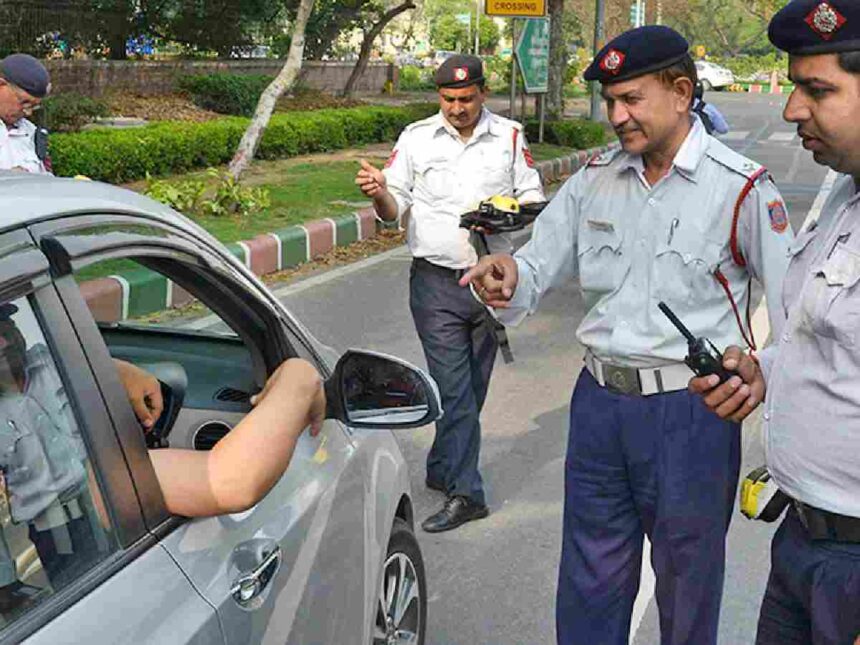
A senior transport official explained that the enforcement process has evolved. “Earlier, checks were sporadic and largely manual. In the last few years, the Delhi government has adopted technology-driven enforcement — including ANPR cameras, randomized checkpoints, and database cross-verification. These have helped us to identify violators faster and in larger numbers,” he said.
The data also shows trends in particular zones: East, North, and West Delhi recorded the highest number of violations, propelled by a mix of dense traffic, older vehicle ownership, and lower compliance rates. But PUC fines went up across all districts, underlining a wider behavioral challenge among commuters.
Environmental experts say the figures point to progress and gaps that refuse to go. Vehicle emissions are estimated to form nearly 40% of Delhi’s winter air pollution, especially during the peak smog months of October to January. The fact that so few vehicles have valid PUC certification suggests large numbers of them-especially older ones-are probably spewing out pollutants at levels considerably higher than the permissible limits and are contributing to increasing the city’s strained air quality.
Sunita Narain, DG of CSE, said, “Enforcement data shows that the authorities have become more vigilant and that is a positive sign. But fines alone cannot solve the problem. We need better access to PUC centres, stricter audits of these centres and incentives for people to retire or replace old and polluting vehicles.”
Transport officials also cited the need to enhance the quality and credibility of PUC testing centres. There are cases of several centres that have come under scrutiny in recent years for issuing certificates without proper testing. The Delhi government reportedly started a phased upgrade plan that includes automated testing lanes and AI-assisted emission tracking to ensure accuracy and prevent malpractice.
Vehicle users remain divided on the issue. A section of commuters say the steep fine is needed to ensure compliance in a city choked by toxic air, while others maintain authorities must improve infrastructure and monitoring first before slapping such hefty fines on its citizens. “The fine is too high. Rather than just punishing us, the government should make PUC testing more accessible and faster,” Rajesh Khanna, a resident of Rohini, said after being penalised during a routine check.
The Transport Department also reported a sharp increase in compliance during the winter months, when pollution levels rise and the checks become more intense. As many as 30% of the challans issued were from special drives conducted in the last two winters alone. As Delhi heads into yet another winter with air quality already hovering in the ‘very poor’ category, the enforcement numbers underline the need for stronger emission controls. With ₹78 crore collected in penalties over five years, officials say the focus must now shift from punitive action to long-term systemic change — including cleaner fuel adoption, electrification of transport, and expansion of public mobility choices. For now, the city’s challenge remains twofold: ensuring that every vehicle on the road carries a valid PUC certificate and, simultaneously, building a cleaner and sustainable mobility ecosystem that reduces the dependency on polluting private vehicles.