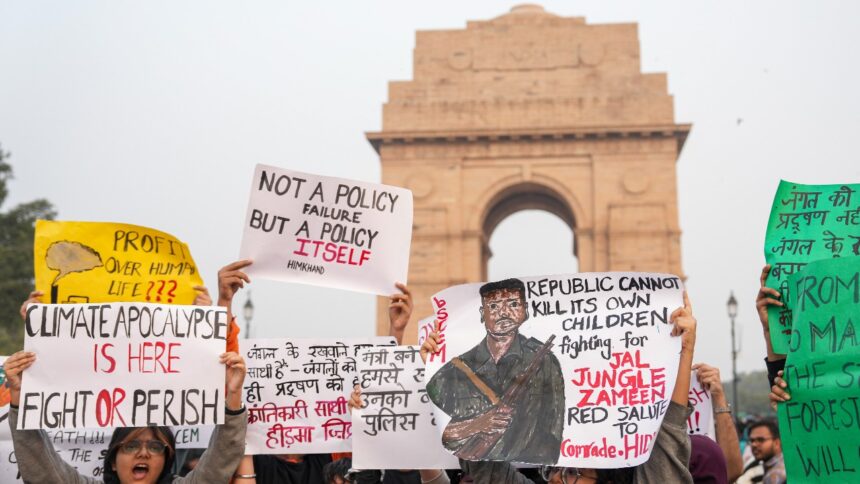
A protest demanding urgent action against Delhi’s worsening air pollution took an unexpected and chaotic turn at India Gate on Sunday, leaving the capital’s law-enforcement agencies scrambling to restore order. What started out as a peaceful demonstration by environmental activists quickly degenerated into a confrontation with the police after some protesters allegedly sprayed chilli/pepper spray at the officers and shouted objectionable slogans.
Organized by several citizen groups and youth organizations, the protest aimed to draw attention to the deteriorating quality of Delhi’s air, which has hovered between “very poor” and “severe” for weeks. Hundreds of protesters assembled at the iconic India Gate lawns carrying placards, wearing anti-pollution masks, and chanting slogans demanding aggressive measures to curb vehicular emissions, reduce industrial pollution, and improve public transportation.
The event remained peaceful for the first hour as a sit-in was staged and speeches were delivered on hazardous air posing a public health hazard. Tensions rose when a faction of more aggressive demonstrators attempted to move closer to the restricted zone near Amar Jawan Jyoti, where already Section 144 was enforced due to the ongoing security protocols. The police intervened to block the movement by asking the crowd to remain within the permitted boundaries.
According to Delhi Police officials, it was during this standoff that some protesters allegedly resorted to using pepper spray, targeting officers who were trying to disperse the crowd. The sudden use of the spray left several policemen irritated and temporarily immobilised, escalating the situation dramatically. Videos from the scene, which have gone viral on social media, show officers shielding their faces and retreating for a brief period when the crowd surged forward.
Matters became worse when a section of protesters started raising slogans in support of Madvi Hidma, a Maoist leader wanted in various cases of violence. The emergence of such politically charged and extreme slogans during an environmental protest created serious concern for security agencies. According to officials, the shouting of pro-Hidma slogans converted what was expected to be a civic demonstration into a law-and-order problem.
Following these developments, police registered two FIRs—one under sections relating to unlawful assembly, obstruction of public servants, and use of criminal force; and another under provisions of the Unlawful Activities (Prevention) Act (UAPA) for raising slogans allegedly glorifying an outlawed extremist figure. By late evening, at least 22 protesters were detained, including those suspected of using pepper spray.
Participants who witnessed the incident described how, though the vast majority of protesters remained peaceful, “a handful of instigators” turned things volatile. Several activist groups distanced themselves from the violent faction, saying their only agenda was to push the government to address Delhi’s public health emergency. “We came here to demand breathable air for our families,” said a participant. “We condemn any violence or political hijacking of our movement.”
Delhi police said in a statement that they showed restraint and only used minimal force to disperse the gathering when the protest turned unlawful. Senior officials further warned that attempts to disrupt civic movements with extremist messaging or criminal actions would be dealt with sternly. More security personnel were deployed around India Gate and other adjoining areas like Kartavya Path and Central Vista to prevent further escalation.
This has indeed been a turn of events that has sparked debate on social media and civil society platforms. Some feel that the authorities should have allowed civic expression in a peaceful manner, instead of restricting movement. Others felt stringent action was needed, given the sudden change in character of this protest. Environmental groups, too, expressed apprehension that the incident may deflect attention from the core issue at stake-the alarming air-quality crisis in Delhi.
Public health experts, meanwhile, warn that Delhi’s pollution levels remain alarmingly high, especially for children, the elderly, and those with respiratory diseases. Its AQI has recorded values over 350–400 in many pockets, falling in both “very poor” and “severe” categories. Long-term exposure to such air quality predisposes residents to lung diseases, cardiovascular issues, and shortened life expectancy. As the controversy unfolds, the bigger challenge remains: how to channel citizens’ frustration into productive dialogue and effective policy action. The India Gate incident underlines not just the emotional intensity of Delhi’s pollution problem but also the need for safe, organized platforms where grievances can find expression without compromising public safety. The detained persons will be produced before the court after further verification and identification. The authorities have assured that peaceful citizens would not be targeted but people linked with violence would receive strict legal action. With pollution levels unlikely to improve immediately, more demonstrations are expected over the coming weeks, making law-and-order preparedness and responsible civic participation more critical than ever.