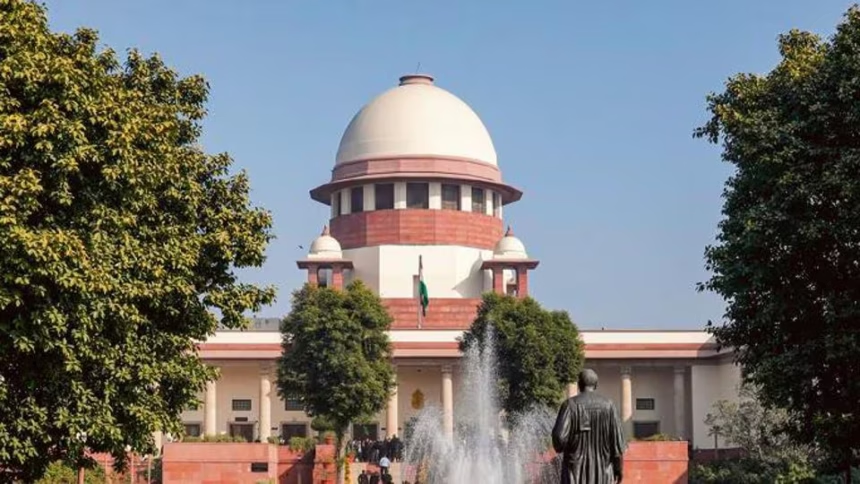
Supreme Court Cancels CBI Probe in Ambience Mall Land Use Case
In a major relief for the Ambience Group, the Supreme Court has scrapped the Central Bureau of Investigation probe ordered by the Punjab and Haryana High Court into alleged land-use violations linked to the Ambience Mall project.
In a detailed and strongly worded judgment, the apex court held that the high court had acted on incorrect assumptions, overlooked key documents, and ignored significant delays by the petitioners. The ruling effectively clears the developer of allegations related to misrepresentation, illegal land use, and reduction of green spaces.
What Was the Case About?
Allegations by Flat Owners
The case originated from a petition filed by residents of the Ambience Lagoon housing project, who alleged that the developer had misused land originally meant for residential purposes by constructing a commercial complex, including Ambience Mall and the Leela Ambience Hotel.
They claimed that this commercial development reduced green areas and common amenities promised to them at the time of purchase. The high court had earlier accepted these claims and ordered a CBI investigation into the matter.
Supreme Court’s Key Finding: No Misrepresentation
Apartment Buyers’ Agreement Was Clear
A bench of Justices JB Pardiwala and Sandeep Mehta closely examined the Apartment Buyers’ Agreement signed in 2001. The court found that the agreement clearly stated that the residential project would be developed on 10.98 acres out of the total licensed land of 18.98 acres.
The remaining land, as per the agreement, was earmarked for commercial use. According to the court, this arrangement was openly disclosed and formed part of the contractual understanding between the developer and the buyers.
The judges noted that the flat owners had never claimed ignorance of this clause in their original petitions.
Court Rejects Claim of Forced Signatures
“Sign on the Dotted Line” Argument Dismissed
One of the key arguments accepted by the high court was that buyers were allegedly forced to sign the agreement without being fully informed.
The Supreme Court firmly rejected this claim. It observed that this argument was raised only at a later stage in a rejoinder and was not part of the original pleadings.
The bench described the high court’s conclusion on this point as speculative and unsupported by evidence. According to the apex court, there was no material to suggest that the agreement was executed under misrepresentation or coercion.
Layout Plans and Land Use Were Approved
High Court Ignored Official Documents
The Supreme Court faulted the high court for assuming that the entire 18.98 acres were meant exclusively for residential development.
In reality, the approved layout plans and official records showed that only 10.98 acres were sanctioned for housing, while the remaining land was lawfully designated for commercial development.
This incorrect assumption, the bench said, led the high court to wrongly conclude that green areas and amenities were reduced.
Commercial Construction Was Not a Secret
Mall and Hotel Built Years Earlier
The apex court highlighted that construction of Ambience Mall and the Leela Ambience Hotel began as early as 2002 and was completed by 2007–08.
By that time, residents had already moved into their flats. Given this timeline, the court found it implausible that flat owners were unaware of commercial activity on the adjoining land.
The judges noted that the silence of the residents for nearly a decade raised serious doubts about the genuineness of their claims.
Delay Proved Fatal to the Petition
Writ Filed After Almost 10 Years
The Supreme Court placed strong emphasis on the delay in filing the writ petition. The residents approached the court only in 2015, years after the commercial structures were completed and operational.
Such a long delay, the bench said, should have been enough to deny relief under Article 226 of the Constitution, which is discretionary in nature.
The court described the delay as gross and unexplained, weakening the credibility of the petitioners.
DTCP Order Supported the Developer
Land De-Licensing Found Legal
The judgment relied heavily on a 2021 order passed by the Director of Town and Country Planning. This order had examined the legality of de-licensing eight acres of land initially reserved for Phase II residential expansion and re-licensing it for commercial use.
The DTCP concluded that the move was legally valid and backed by statutory powers. It was also retrospectively validated by amendments made to the Haryana Development and Regulation of Urban Areas Act in 2020.
According to the Supreme Court, this order decisively settled the controversy in favour of the developer.
No Grounds for CBI Investigation
High Court Acted on Inconclusive Material
The Supreme Court came down heavily on the high court’s direction to order a CBI probe.
It ruled that such a serious step was taken without verified or conclusive material. The bench noted that even the CBI, after registering an FIR and filing a charge sheet, found that the de-licensing of land was in accordance with the law.
The only alleged illegality flagged by the agency related to supposed misrepresentation in the Apartment Buyers’ Agreement, a claim the Supreme Court has now rejected.
Warning Against Prejudicing Ongoing Cases
Impact on Criminal Trial and Other Petitions
The apex court warned that allowing the high court’s judgment to stand could unfairly affect ongoing legal proceedings, including a pending criminal trial and a separate writ petition challenging the DTCP’s 2021 order.
To prevent overlapping and conflicting outcomes, the court said the high court judgment had to be set aside in its entirety.
NGT Proceedings Put on Hold
Environmental Issues Linked to Land Dispute
The Supreme Court also stayed proceedings before the National Green Tribunal. It observed that environmental issues raised in the matter were closely connected to the land-use dispute already under judicial consideration.
The bench stayed the NGT’s order that had constituted an expert committee and recommended penalties exceeding ₹140 crore, along with environmental compensation and even demolition.
The court clarified that NGT proceedings would remain paused until the pending writ petition before the high court is decided.
Legal Team and Representation
Senior Advocates Led the Defence
The Ambience Group and its promoter Raj Singh Gehlot were represented by senior advocates Mukul Rohatgi and Abhishek Manu Singhvi, assisted by lawyers from Karanjawala & Co.
The court acknowledged the detailed submissions made on behalf of the developer, which were supported by contractual documents, statutory approvals, and official records.
Why This Judgment Matters
A Strong Message on Judicial Caution
This ruling sends a clear message that courts must exercise caution before ordering high-profile investigations like CBI probes. The Supreme Court underscored that such directions should be based on solid evidence, not assumptions or delayed grievances.
It also reinforces the importance of respecting contractual terms and approved development plans, especially in complex urban development cases.
Final Takeaway
The Supreme Court’s decision brings significant closure to a long-running dispute over the Ambience Mall project. By scrapping the CBI probe and criticising the high court’s reasoning, the apex court has reaffirmed the principle that allegations must be backed by facts, timely action, and credible material.
For developers, residents, and policymakers alike, the judgment serves as a reminder of the importance of transparency, documentation, and adherence to legal timelines in urban development disputes.