Fresh Political Storm in Delhi: AAP Accuses CM Rekha Gupta of Removing Ambedkar and Bhagat Singh Portraits
Delhi’s political landscape witnessed a sudden escalation on Saturday after the Aam Aadmi Party accused Chief Minister Rekha Gupta of removing portraits of Dr Bhimrao Ambedkar and Shaheed Bhagat Singh from prominent government spaces. The allegation, surfacing on Ambedkar’s death anniversary, quickly ignited a heated exchange between the AAP and the BJP, reflecting once again how symbolic icons remain at the heart of political identity battles in the capital.
AAP Raises Strong Questions: Why Were the Portraits Removed?
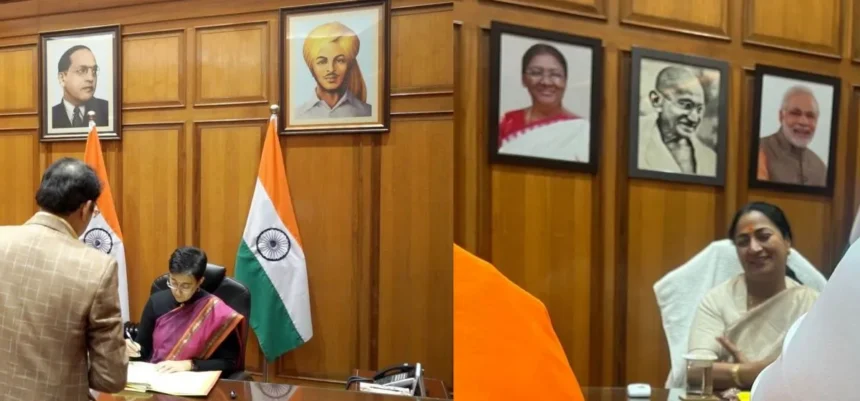
The charge was led by AAP legislator and former minister Saurabh Bharadwaj, who questioned the reason behind the removal. According to him, both portraits were visible behind former Chief Minister Arvind Kejriwal and other AAP leaders during official interactions. He pointed to earlier photographs from the Kejriwal and Atishi tenure, where images of Ambedkar and Bhagat Singh were displayed prominently.
Bharadwaj contrasted these visuals with recent images of Rekha Gupta’s meetings, where only a portrait of Prime Minister Narendra Modi can be seen behind the Chief Minister. For him, this shift was not just about decoration—it was about ideology.
He asked a pointed question: Why this hatred? Why were two of India’s most respected icons removed on a day associated with Ambedkar’s memory?
The Symbolism Behind Ambedkar and Bhagat Singh
The two portraits in question are far more than simple wall adornments. Dr Bhimrao Ambedkar is seen as the architect of modern India’s Constitution and a symbol of equality and justice. Shaheed Bhagat Singh represents courage, revolution, and the fight against colonial rule.
AAP has long used their portraits as a visual representation of its political identity, emphasizing constitutional values, social justice, and youth-led patriotism. Therefore, any removal becomes a politically loaded action.
Bharadwaj argued that their absence signifies an ideological shift under the BJP-led administration in Delhi.
BJP Faces Familiar Accusations
Interestingly, this is not the first time such allegations have surfaced. Earlier in February 2025, AAP legislators staged protests inside the Delhi Assembly over similar claims that portraits of Ambedkar and Bhagat Singh were missing from the Chief Minister’s office. At that time, AAP accused the BJP of undermining constitutional principles and distancing itself from icons who symbolize social justice.
The BJP dismissed these claims then, calling them baseless attempts to create controversy. Saturday’s allegation adds another chapter to this recurring dispute.
What Makes This Controversy Different?
The timing is critical. The allegation was made on Ambedkar’s death anniversary—a day when leaders across political lines pay tribute to his contributions. AAP claims that removing his portrait on this day shows a lack of sensitivity and respect.
Moreover, as Bharadwaj noted, this issue is not about administrative restructuring but about symbolic respect. For AAP, Ambedkar represents the idea of governance rooted in constitutional morality. For the BJP, the claim goes against its own assertion that it respects Ambedkar’s legacy and has worked to preserve and promote his teachings.
This clash plays into the broader ideological struggle between the two parties.
Portraits as a Political Battlefield
In Indian politics, symbols matter—sometimes even more than spoken words. Portraits of national icons inside government offices are seen as declarations of ideology. They signal what a leader stands for, what values guide the administration, and what historical legacy it aligns with.
AAP has long curated its political imagery around Ambedkar and Bhagat Singh. Their faces have become synonymous with the party’s narrative: rule by the Constitution and anti-corruption patriotism.
On the other hand, political opponents have often accused AAP of using their images selectively for electoral branding.
The BJP, meanwhile, champions its own set of national icons, including Sardar Patel and Deen Dayal Upadhyaya. The prominence of the Prime Minister’s portrait in the new office setup fits within the BJP’s broader political messaging.
Thus, the removal—or even the perceived removal—of portraits becomes a potent political instrument.
AAP’s Argument: A Shift in Values
Bharadwaj argued passionately that the absence of Ambedkar’s portrait symbolizes a departure from constitutional ideals. For him, the visual landscape of the Chief Minister’s office reflects the values being upheld. He claimed that every official photo and video during Kejriwal’s tenure prominently displayed Ambedkar.
He added that removing the portraits does not only erase symbols but risks erasing the commitments they represent—social equality, justice, and democratic ethics.
According to him, this is not an administrative decision but a deeper ideological statement.
BJP Yet to Respond Officially
As of the time of the controversy breaking, BJP leaders have not issued a detailed rebuttal. In the past, however, they have rejected similar allegations, accusing AAP of deliberately manufacturing controversies to distract from governance failures or legal troubles faced by its leadership.
Political observers expect an official clarification soon, given the sensitivity of the issue.
The Larger Implication: Delhi’s Political Identity Crisis
This controversy highlights a recurring theme in Delhi politics: the fight to define the capital’s moral and ideological identity. With elections approaching and political narratives hardening, every action—no matter how symbolic—becomes a battleground.
Portraits, slogans, ceremonial gestures, even office decor turn into political ammunition.
For voters, this episode once again raises questions: Who represents Ambedkar’s values? Who speaks for Bhagat Singh’s legacy? Whose governance model aligns with constitutional integrity?
These debates, although symbolic, influence how parties shape their image in the minds of citizens.
Why Such Issues Keep Returning
There are a few key reasons why these portrait-related controversies keep resurfacing:
- Icons Carry Emotional Weight
Ambedkar and Bhagat Singh provoke powerful reactions across communities. Any change involving their symbols creates immediate public attention. - Visual Politics Works Faster Than Policy Debate
A missing portrait can go viral in minutes. It is easier for parties to mobilize support around symbolic issues than complex administrative discussions. - Ideological Positioning
Both AAP and BJP want to be seen as the true guardians of national values. Such controversies help them define their rivals. - Election-Time Narrative Building
Portrait-related allegations intensify in the months leading to elections when parties want to reinforce their ideological image.
What Happens Next?
With the matter already making headlines, a political back-and-forth is expected. AAP will likely push the narrative further, demanding explanations and public accountability. The BJP may counter by accusing the party of stirring unnecessary drama.
Whether the portraits were actually removed or simply repositioned remains unclear, as AAP has not shown recent photographs of the office interior beyond media images. A factual clarification from the Chief Minister’s office may soon settle some of the debate, but politically, the issue is unlikely to fade quickly.
The controversy over whether Chief Minister Rekha Gupta removed portraits of Dr Ambedkar and Shaheed Bhagat Singh has triggered yet another ideological clash in Delhi. Coming on Ambedkar’s death anniversary, the issue has added emotional and symbolic urgency to an already charged political environment.
As both sides prepare for a prolonged showdown, one thing is clear: in Delhi’s political arena, symbols matter, and portraits on a wall can spark storms that go far beyond the confines of an office.