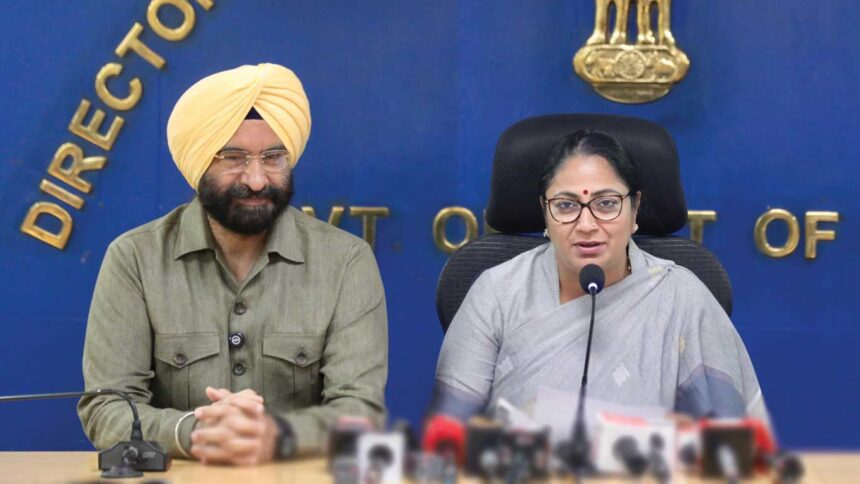
In a major effort to enhance the functioning and support ecosystem for the business community in the city, the Delhi government has formally set up the long-awaited Delhi Traders Welfare Board to look into the grievances and operational challenges faced by traders. At the same time, the Delhi Development Authority (DDA) has announced a fresh clean-up and upkeep exercise for Nehru Place, one of Asia’s largest commercial hubs, amidst persistent complaints over poor sanitation, clogged drains, and lack of adequate civic services.
Together, these developments mark a major push towards overhauling the capital’s public infrastructure and business environment.
A Dedicated Welfare Body for 8 Lakh Traders
The new Delhi Traders Welfare Board will play the role of a nodal coordinating agency for over 8 lakh traders operating all over the national capital. Traders’ associations have been demanding a dedicated body that would deal directly with them, fast-track solutions to their problems, and extend systematic support to businesses facing regulatory and civic obstacles.
According to officials, the key objectives of the Board would include:
Facilitating easier communication between government departments and traders.
Reviewing issues relating to licensing, taxation, parking, market redevelopment, and shop safety.
Establish welfare schemes and support systems for small and medium traders.
Providing a single redressal mechanism to ensure timely addressal of grievances.
The Board will also focus on policy suggestions for modernizing the markets, providing digital services to shop owners, and ensuring better coordination in peak trading seasons, especially during festivals, said senior government representatives.
The move has been largely welcomed by traders across Delhi, who termed it a step ahead in recognizing the economic contribution of local market ecosystems. “For years, we have been raising concerns about parking chaos, outdated infrastructure, and bureaucratic delays. A dedicated Board can finally help streamline these issues,” said a shopkeeper from Chandni Chowk Market.
Nehru Place to Undergo Large-Scale Clean-Up Operation
In tandem with this development, the DDA has initiated plans to appoint a new agency responsible for the cleaning, sanitation, and maintenance of Nehru Place, a commercial district that hosts thousands of businesses ranging from technology retailers to textile wholesalers.
Nehru Place has received several criticisms from traders and visitors on account of:
Mounting heaps of garbage.
Broken footpaths and uneven walking areas.
Waterlogging due to blocked drains.
Public toilets that are not well maintained.
Lack of structured waste-collection systems.
Such deteriorating conditions do not affect daily commerce alone; instead, they also blemish the reputation of Nehru Place as a major commercial hub.
The new clean-up plan reportedly involves :
Deployment of additional sanitation workers across the complex.
Regular mechanized sweeping and disposal of garbage.
Monthly audits of cleanliness and infrastructure.
Clear clogged drainage systems to prevent monsoon flooding.
Improved maintenance of public washrooms, lighting, and common spaces.
DDA officials also said that CCTV surveillance may be expanded to monitor waste dumping and vandalism in the area. Traders said they are relieved as they had repeatedly approached the civic bodies to fix basic issues but received only temporary solutions.
A Boost for Business and Urban Management
Both the establishment of a Traders Welfare Board and the renovation at Nehru Place are bound to have a combined beneficial effect on the thousands of businesses reliant on stable infrastructure and smooth support services. A well-maintained marketplace ensures better customer inflow and facilitates the ease of doing business for small retail owners, an integral component of Delhi’s urban economy.
As any town planner will tell you, commercial hubs need sustained maintenance, not sporadic cleaning. The professionals say Nehru Place’s problems became chronic because responsibilities were divided among multiple agencies, each working at cross purposes. The conditions would improve substantially if a single contractor was in charge, with clear accountability and periodic reviews.
The Delhi government, for its part, has underlined that these measures represent the first steps in a more extensive initiative to renovate markets, raise sanitation, improve infrastructure, and sharpen the relationships between traders and the government. If these reforms are carried out effectively, they will act as a template for how to manage other key commercial areas within the city, like Lajpat Nagar, Karol Bagh, and Connaught Place. Conclusion As Delhi continues to grow economically, the health of its markets becomes essential for sustained economic growth. The constitution of the Traders Welfare Board and the fresh attention being paid to Nehru Place’s upkeep have raised hopes that the capital city is serious about offering a better business environment. For traders fighting daily operational challenges, these steps bring fresh hope that long-pending problems may get lasting solutions.