

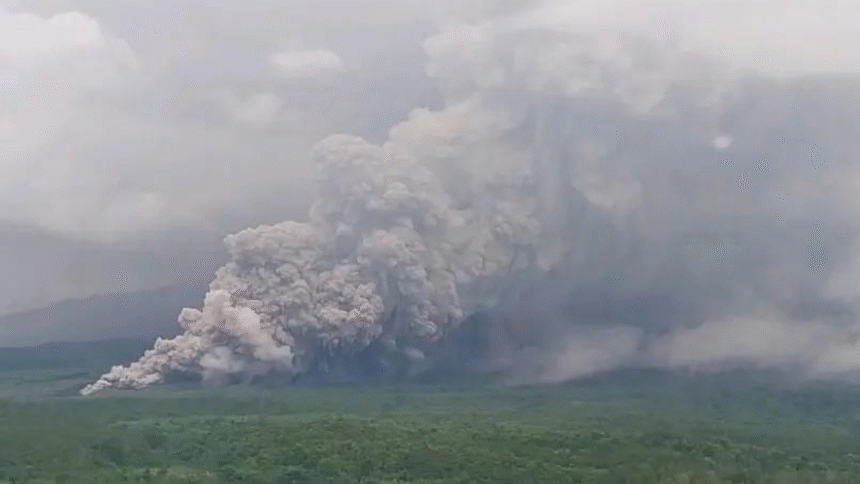
A massive cloud of volcanic ash released by Monday’s eruption in Ethiopia swept across India on Tuesday, drifting over Gujarat, Rajasthan, Delhi-NCR, Uttar Pradesh, Bihar and the northeast before moving toward China, the India Meteorological Department (IMD) said. Despite its dramatic path, officials confirmed that the plume had no significant impact on Delhi’s already poor air quality.
Aviation, however, suffered major disruptions as airlines cancelled, diverted or delayed flights due to rapidly changing upper-air conditions.
Volcanic Ash Crosses India in High-Altitude Journey
Carried by strong westerly winds, the ash plume travelled across Yemen, Oman and the Arabian Sea before entering India over Gujarat and Rajasthan around 6:30pm on Monday. By 11pm, the cloud’s outer layers had reached Delhi at altitudes of 9 km to 15 km, continuing eastward at high speed.
IMD chief M Mohapatra said satellite imagery confirmed that the plume had completely exited Indian skies by 10:30pm on Tuesday, except for a thinning tail over the northeast.
“These ash particles were travelling between 8–15 km above the surface, so there was no impact on ground-level weather or pollution,” Mohapatra said. “Wind speeds of 100–150 kmph ensure they move away before any meaningful settling.”
Flights Hit Hard Across Delhi, Mumbai, Kolkata Sectors
The high-altitude ash led aviation regulators to issue advisories, prompting major disruptions:
Airlines affected
- Air India cancelled seven flights on Monday and four on Tuesday, including Chennai–Mumbai and Hyderabad–Delhi routes. The airline said it is conducting precautionary checks on aircraft that crossed affected regions.
- Akasa Air cancelled several international services to and from Jeddah, Kuwait and Abu Dhabi on November 24 and 25.
- IndiGo diverted flights, including its Kannur–Abu Dhabi service, which landed in Ahmedabad to avoid the ash cloud.
At Delhi’s IGI Airport, seven international flights were cancelled and 12 delayed by 6pm Tuesday.
The ministry of civil aviation said it was working closely with ATC, IMD and international agencies, adding that only a limited number of flights required rerouting or altitude changes.
Delhi Pollution Levels Unaffected
Despite initial concerns that the ash could worsen Delhi’s hazardous air, ground-level air quality remained largely unchanged.
Delhi’s AQI:
- 370 at 11pm Monday (as the plume skimmed the city)
- 353 by 4pm Tuesday
Real-time pollutant data showed only minor, inconsistent fluctuations:
Examples:
Mandir Marg
- PM2.5: 173 → 185 → 218 µg/m³
- SO₂: 41.3 → 61.8 µg/m³
Anand Vihar
- PM2.5: 328 → 382 µg/m³
- SO₂: 9.2 → 12.9 µg/m³
Punjabi Bagh
- PM2.5: 306 → 345 µg/m³
- SO₂ dipped slightly
Experts say these variations are typical for Delhi and not attributable to the plume.
Why the Ash Didn’t Affect Breathing Air
Prof Abhineety Goel of FLAME University explained that the plume was travelling between 27,000 and 50,000 feet, well into the stratosphere.
“Delhi’s pollution stays trapped in the troposphere at much lower altitudes,” she said. “While heavier volcanic particles may slowly settle, they are more likely to affect soil, vegetation or water bodies rather than immediate air quality.”
The primary risk remained aviation-related, not public health.
IMD Also Warns of Heavy Rainfall in South India
In a separate forecast, the IMD said multiple low-pressure systems over the Bay of Bengal and the Strait of Malacca will bring widespread rainfall to Peninsular India.
IMD Rainfall Outlook
- Tamil Nadu: Heavy to very heavy rain till November 30
- Kerala & Mahe: November 26
- Coastal Andhra Pradesh, Yanam, Rayalaseema: Nov 29 – Dec 1
- Andaman & Nicobar Islands: Till Nov 29, with very heavy rain Nov 26–27
“We can expect widespread rain over parts of Peninsular India,” Mohapatra added.


