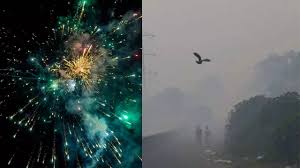
Delhi’s Air Quality Crashes to ‘Severe’ Level
Delhi woke up to a blanket of toxic haze once again as its air quality dropped into the ‘severe’ category, forcing the Centre to invoke Stage 3 of the Graded Response Action Plan (GRAP) on Tuesday.
According to the Commission for Air Quality Management (CAQM), the city’s average Air Quality Index (AQI) jumped sharply from 362 on Monday to a dangerous 425 on Tuesday morning — levels considered hazardous for all residents, regardless of health conditions.
The reason? Calm winds, a stable atmosphere, and unfavourable weather conditions that allowed pollutants to stagnate close to the ground — effectively trapping Delhi under a thick dome of smog.
What the Government Has Ordered
The CAQM Sub-Committee held an emergency meeting early Tuesday and decided to activate Stage 3 of GRAP, a set of stricter anti-pollution measures designed to combat “severe” air quality (AQI between 401–450).
This comes in addition to Stage 1 and 2 measures that were already in force across the National Capital Region (NCR).
In a statement, the CAQM said:
“Keeping in view the prevailing trend of air quality and to prevent further deterioration, the Sub-Committee has taken the call to invoke all actions under Stage-III of the GRAP with immediate effect in the entire NCR.”
What Stage 3 of GRAP Means
Stage 3 restrictions are among the toughest anti-pollution measures short of a full emergency (Stage 4). Here’s what it includes:
1. Construction and Demolition Ban
- All non-essential construction and demolition activities are immediately banned.
- Only emergency public projects like railways, metro, airport, and defense-related work are exempt.
2. Restrictions on Brick Kilns and Factories
- Hot mix plants, stone crushers, and manufacturing units using unapproved fuels must stop operations.
- Industrial units running on cleaner fuels such as PNG (piped natural gas) can continue under strict compliance.
3. Entry Ban on Polluting Trucks
- Entry of diesel commercial vehicles into Delhi will be heavily restricted, except for those carrying essential goods.
- Older and non-BS VI compliant vehicles are particularly targeted in enforcement drives.
4. Dust and Road Pollution Control
- Agencies must intensify mechanical sweeping, water sprinkling, and dust suppression on roads.
- Open burning of waste is strictly prohibited, with penalties for violators.
5. Parking and Vehicle Use Curbs
- Public is advised to work from home, use public transport, and avoid private vehicles wherever possible.
- Government departments and private offices may consider carpooling or staggered working hours.
Why Delhi’s Air Quality Collapsed Again
Delhi’s battle with pollution follows a familiar seasonal pattern. Each year, as temperatures drop in early winter, stubble burning in Punjab and Haryana, coupled with vehicle emissions, industrial pollution, and construction dust, pushes the city’s air quality to dangerous extremes.
This week, meteorological conditions worsened the situation. Calm winds and a temperature inversion — when warm air traps colder air near the surface — prevented pollutants from dispersing, creating a toxic cloud that blanketed the city.
Experts say the air quality is likely to remain in the “severe” category for the next few days unless strong winds help clear the pollutants.
How ‘Severe’ Air Quality Impacts Health
The “severe” AQI level means the concentration of PM2.5 and PM10 particles — tiny pollutants that can enter the lungs and bloodstream — has crossed safe limits many times over.
Health experts warn that prolonged exposure can cause respiratory distress, coughing, fatigue, and even heart complications.
Children, the elderly, and those with pre-existing health conditions are particularly at risk. Doctors are advising Delhiites to stay indoors, use N95 masks, and run air purifiers at home if possible.
Previous Air Pollution Episodes and Response
Delhi’s air quality crisis is not new. The national capital routinely records one of the worst AQI levels in the world during October–November.
In the first week of November, the AQI had already touched the “very poor” category, prompting authorities to enforce Stage 2 of GRAP — which includes bans on diesel generators and tighter construction dust control.
However, as conditions worsened, the Stage 3 escalation became inevitable.
In 2023 and 2024, Delhi witnessed similar emergency measures, including school closures, vehicle restrictions under the odd-even rule, and temporary factory shutdowns. Officials haven’t announced those yet this year, but they may follow if the situation doesn’t improve.
What’s Next for Delhi?
The CAQM will continue to monitor air quality data daily to decide whether Stage 3 restrictions need to remain or escalate to Stage 4 (Emergency Level) if the AQI crosses 450.
Stage 4 could trigger complete construction bans, closure of schools, and halting of all non-essential travel, including private vehicles.
Meteorologists predict that light winds later this week may offer some relief, but not enough to clear the smog entirely.
Until then, authorities are urging citizens to avoid outdoor activities, reduce vehicle use, and report pollution violations through government helplines and apps like “Sameer.”
What You Can Do to Stay Safe
- Limit outdoor exercise or walking during early morning and late evening hours.
- Keep windows and doors closed to prevent polluted air from entering.
- Use air purifiers indoors, especially if you have respiratory issues.
- Stay hydrated — it helps flush toxins from the body.
- If symptoms like breathlessness or throat irritation worsen, seek medical advice immediately.
Final Word
With Delhi’s AQI crossing the 400 mark yet again, the city finds itself gasping for breath as winter begins. The government’s move to invoke GRAP Stage 3 is a desperate but necessary step to prevent the situation from turning catastrophic.
Whether it will be enough depends not just on enforcement — but on how seriously Delhi’s citizens take the call to act responsibly.