As Delhi fights its annual air quality crisis, the city has taken one of its toughest steps so far to curb vehicular pollution — a complete ban on entry of BS-IV and older commercial vehicles from today. The joint enforcement by the Commission for Air Quality Management (CAQM) and Delhi government is aimed at cutting down emissions as the national capital enters the peak winter pollution season.
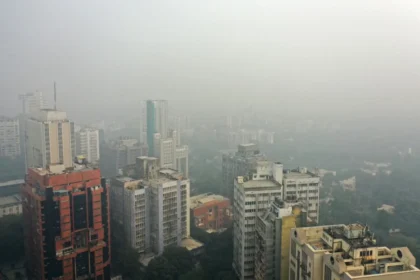
The decision comes at a time when Delhi’s air quality index slipped into the “very poor” category across several monitoring stations, with smog visibly blanketing the city’s skyline. According to CAQM officials, the restriction is part of a larger emergency response under Graded Response Action Plan Stage II, which focuses on controlling emissions from vehicles, construction sites, and industries during pollution spikes.
A Move to Target High-Emission Vehicles
Under the new rule, only BS-VI-compliant vehicles – those meeting India’s latest and cleanest emission standards-are allowed to enter Delhi. Older commercial vehicles, mainly BS-IV diesel trucks and goods carriers, will be stopped at Delhi’s borders and redirected.
This would largely affect non-Delhi registered vehicles, many of which enter daily from neighboring states of Haryana, Uttar Pradesh, and Rajasthan to deliver goods. Essential commodities such as fruits, vegetables, dairy products, and medicines are exempt from the restrictions; all others will face strict penalties in case of non-compliance.
“Delhi cannot breathe freely unless we tackle vehicular emissions head-on,” a CAQM spokesperson said. “The data clearly shows that vehicles contribute over 30% of Delhi’s total particulate matter load during winter. Limiting high-emission vehicles is an immediate and necessary step.”
Enforcement and Penalties
For the process, Delhi Traffic Police, in coordination with the Transport Department, has established 24×7 checkpoints at major entry points like Singhu, Ghazipur, Tikri, and Kalindi Kunj. Surveillance drones and ANPR cameras have been deployed to identify violators.
Those found flouting the ban will be fined up to ₹20,000 as per the Motor Vehicles Act. Repeat offenders can get their vehicles impounded. The government has coordinated with the neighboring states so that such vehicles are stopped before they reach Delhi’s borders.
The Delhi government has asked the logistics companies and small transporters to switch over to CNG, electric, or BS-VI vehicles to continue operations without disruptions. As part of the government’s greater drive for greener transport, CNG and EVs are wholly exempt from the ban.
Pollution and Public Health Concerns
The problem of pollution in Delhi is multidimensional, with vehicular emissions being one of the biggest contributors; this is especially true in the winter months when stubble burning, low wind speed, and temperature inversion trap pollutants near the ground. AQI touched 320 in many parts of the city this week, indicating “very poor” quality air that can severely affect people with respiratory illnesses.
The move, however, has been welcomed by health experts, who indicated that reducing vehicular emissions could bring immediate relief. “Exposure to vehicular pollution is linked to rising cases of asthma, bronchitis, and cardiovascular diseases,” said Dr Neha Bansal, a pulmonologist at Safdarjung Hospital. “Restricting older diesel vehicles is a scientifically sound step, especially for a city like Delhi that’s on the frontline of India’s air quality crisis.”
Balancing Environment and Economy
While environmentalists have hailed the move, small businesses and transporters who depend on interstate goods movement have expressed apprehension. Some trade associations have sought a transition period in phases, saying abrupt increase in enforcement creates costs and supply chain disruptions.
“Most small transporters still operate BS-IV trucks. Upgrading to BS-VI vehicles or EVs is expensive,” said Ramesh Yadav, a truck operator from Ghaziabad. “We support clean air, but the government must also support us with incentives or scrappage schemes.”
Officials, however, insist that the health and environmental benefits outweigh any short-term inconveniences. The Delhi government has indicated that under its ‘Switch Delhi’ campaign, subsidies for electric commercial vehicles and expansion of CNG infrastructure will continue to encourage faster adoption of cleaner mobility.
A Step Toward Sustainable Urban Living
Experts see this ban as a turning point, provided it is implemented stringently. The earlier pollution control measures taken by Delhi, like the Odd-Even scheme and restrictions on construction activities, showed temporary gains but did not sustain long-term results. “This step means that, for the first time, Delhi is prioritizing long-term air quality management over short-term convenience,” said Sunil Kumar, a researcher of environmental policy. “If sustained, it can be a model for other Indian cities facing a similar predicament.” As the city prepares for another smog-filled winter, the success of this vehicle entry ban will be largely reliant on stern enforcement and regional coordination. For millions of residents who wake up every day under a haze of pollution, the promise is that cleaner air may finally be on the horizon.