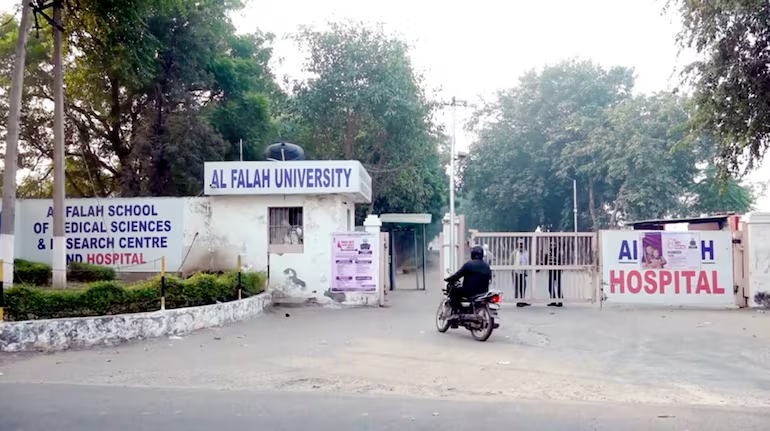
Delhi NCR and Faridabad have become the focus of a sweeping counter-terrorism operation with the Enforcement Directorate conducting coordinated raids at more than 25 locations linked to Al‑Falah University and its associated trust. Officials describe the probe as part of a “white-collar terror module”, blending radical activities with professional and academic fronts.
These raids come in the aftermath of a car explosion near Delhi’s Red Fort on November 10, a blast that killed several people and is being investigated as a terrorist attack. The vehicle used in the blast has been traced to people associated with Al‑Falah University. The suspected driver of the vehicle, among those under scrutiny, is Dr. Umar Un‑Nabi, a staff member, together with other faculty allegedly linked to extremist activities.
Focus of the Investigation
The ED investigation is largely financial, related to shell companies, suspicious fund flows, and money laundering that could support terror activities. The authorities have ordered a forensic audit of Al‑Falah University in order to trace donations, examine operational funding, and find out if the institution’s resources were misused.
The police are also investigating whether any university labs or facilities were used to manufacture the explosives, including RDX and ammonium nitrate. Early reports mentioned that nearly 2,900 kg of explosive and flammable materials were recovered along with rifles, assault weapons, timers, batteries, remote devices, and walkie-talkies.
Over 800 police personnel were deployed around the university and associated sites to conduct searches and secure evidence. These raids constitute some of the most significant counterterrorism operations in recent years and point out the growing concern over sophisticated terror networks operating under professional covers.
White-Collar Terror Network
Officials refer to the emerging terror network as a white-collar ecosystem with professionals, including doctors, nestled within the university. These reportedly kept links with extremist handlers while using their positions to facilitate operations.
Under investigation are four doctors linked to Al‑Falah Medical College: Dr. Umar Un‑Nabi, Dr. Muzammil Shakeel Ganaie, Dr. Shaheen Shahid, and Dr. Nisar-ul-Hassan. The investigating authorities claim that some of these individuals had direct involvement in the planning, logistics, or funding of terror operations. The recoveries of explosives and weapons from places associated with these doctors bring seriousness to the case.
Money Trail and Overseas Funding
The investigation also covers the alleged foreign funding of Al‑Falah University. The government is investigating donations from Gulf countries to ascertain whether funds had been diverted for radical activities. ED has started investigating nine shell companies belonging to or linked with the university or its trustees, for which most have no actual business in operation, although they claimed massive activities.
Experts explain that this case underlines how terror networks can exploit educational institutions to retain legitimacy when secretly engaging in criminal and extremist activities. Such dual uses of professional cover and academic facilities make detection and intervention particularly difficult.
Response by Institutions and Public
Al-Falah University has denied any wrongdoing, claiming that the implicated faculty had no radical affiliations beyond professional responsibilities. Nevertheless, intervention from the regulatory bodies followed: the NAAC issued a show-cause notice, questioning the university’s claims of accreditation, while FIRs have been filed for alleged forgery and misrepresentation of academic credentials.
The raids have sparked public debate on the potential misuse of educational institutions for illegal purposes. Security analysts and the authorities insist that universities, which, in particular, receive foreign funds, have to be kept under tighter monitoring to avoid misuse.
Implications and Next Steps
The Al-Falah case has the following far-reaching implications:
Counterterror Strategy: The case brings forward the need to monitor professional and academic institutions as possible terror fronts.
Financial Governance: Increased scrutiny of donations and funding flows may become the norm for educational entities.
Campus Security: More strict internal controls and auditing may be in order for universities to avoid the radicalization process and misuse of their facilities.
Legal Proceedings: An investigation by ED may result in prosecution under anti-terror financing laws and the Indian Penal Code if wrongdoing is proved. Conclusion The massive raids conducted at Al-Falah University and its affiliates mark a significant escalation in the investigation of the Red Fort blast. The authorities are uncovering an elaborate network that knits professional legitimacy with terror operations-a challenge to conventional approaches toward counterterrorism. As different agencies continue their probe, the case may reshape India’s strategy toward preventing the misuse of academic institutions for extremist purposes, underlining the urgent requirement for vigilance, oversight, and proactive action.