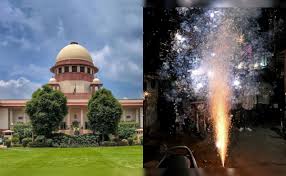
As Delhi and the National Capital Region (NCR) prepare for the coming Diwali festival, the Supreme Court of India released a landmark ruling permitting the sale and consumption of green firecrackers within a highly controlled environment. The ruling, revealed earlier this week, aims to reconcile cultural heritage with public health interests in a city known for toxic air pollution levels during festival seasons.
Context and Rationale
Delhi air quality generally worsens dramatically during Diwali owing to the widespread use of traditional firecrackers, which emit a mix of dangerous particulate matter and gases into the environment. The resulting seasonal increase in pollution is extremely hazardous to health, especially for children, the elderly, and patients with respiratory ailments.
As a response, the Supreme Court has approved the controlled use of green firecrackers—eco-friendly substitutes that profess to release much less smoke and particulate matter. The court ruling prescribes that the burning of firecrackers will be permitted from October 18 through October 21, including the day of Diwali as well as the day before. In order to minimize environmental damage further, usage has been limited to 6–7 AM and 8–10 PM.
Green Firecrackers: A Safer Alternative?
Green crackers, also known as ‘green firecrackers,’ are specifically made with new chemical mixtures to reduce emissions while preserving the festive hues and sounds of conventional crackers. Green crackers are produced under the supervision of the National Environmental Engineering Research Institute (NEERI) and have to be marked with a QR code for verification. Firecrackers certified by NEERI alone will be allowed, so customers will not unknowingly buy conventional crackers.
The decision has been received with cautious approval by experts, who say even though green crackers cause less pollution, they are not entirely safe. The cumulative effect on air quality during the festival must still be countered through constant surveillance and judicious use.
Enforcement and Compliance
The directive from the Supreme Court needs to be enforced sternly at different levels. The law enforcement agencies, civic authorities, and environmental department officials of Delhi-NCR have been entrusted with the responsibility of checking that only NEERI-certified crackers are sold and detonated. The sellers have been directed to keep the QR codes on display and not sell unapproved firecrackers at any cost.
The ruling also shines a light on the timing constraints. By restricting use to early morning and evening time slots, authorities seek to minimize peak pollution hours while making room for residents to engage in traditional festivities.
Public Reactions
There has been a varied public response. Some residents have welcomed the development, grateful that the court is acknowledging the cultural importance of Diwali but taking action to protect health. Others are circumspect, noting that even green firecrackers are a pollutant, and effective enforcement on a large scale may prove difficult in reality.
Environmentalists have reiterated the necessity of having a low-impact Diwali. They have also called on citizens to implement additional practices, including the use of LED lights, reducing large-scale bursting, and encouraging community firecracker activities in open areas to minimize the cumulative impact on air quality.
Broader Implications
The Supreme Court’s ruling is part of a broader effort to tackle Delhi’s persistent air pollution problem. In parallel, the Commission for Air Quality Management (CAQM) has already implemented the Graded Response Action Plan (GRAP), restricting construction activity, diesel generator use, and industrial emissions during high-pollution periods. Combined with initiatives like cloud seeding and public awareness campaigns, these measures reflect a multi-pronged strategy to protect residents’ health while respecting cultural practices.
This ruling can also serve as a precedent for other Indian cities that experience similar issues during festivals. With the requirement of using technology like green firecrackers and including strict regulatory control, authorities can strike a balance between tradition and environmental care.
The green firecracker decision of the Supreme Court is a cautious balancing of cultural festivity and ecological sustainability. In allowing their use for a few days and under certain circumstances, the court would like to curtail air pollution while permitting families to celebrate Diwali.
As people of Delhi-NCR get ready for the festival, public support will be crucial. Responsible buying, careful use, and compliance with the time limits will make or break if this strategy is able to effectively address the seasonal peak pollution. The next few days will tell how well green firecrackers will sell a cleaner, healthier Diwali.